I stayed and worked in Kerala for 16 months as a political consultant. A few months in the state and you realise that you are not dealing with the same electoral instincts that shape politics across much of northern India.
One common phrase we kept on hearing was ‘Kerala/Malayalis are different.’ To which I mockingly used to say, ‘Yes, people in Kerala have four hands, as opposed to the rest of the country.’ Bad jokes apart, yes, Kerala is different in terms of voting behaviour and average voter consciousness.
The difference is not merely in outcomes or party systems, but in how voters think, evaluate, and make political decisions. As someone used to working in states where elections often turn on identity consolidation, narrative waves, or last-mile mobilisation, Kerala forces a recalibration of almost every assumption you carry into a campaign.
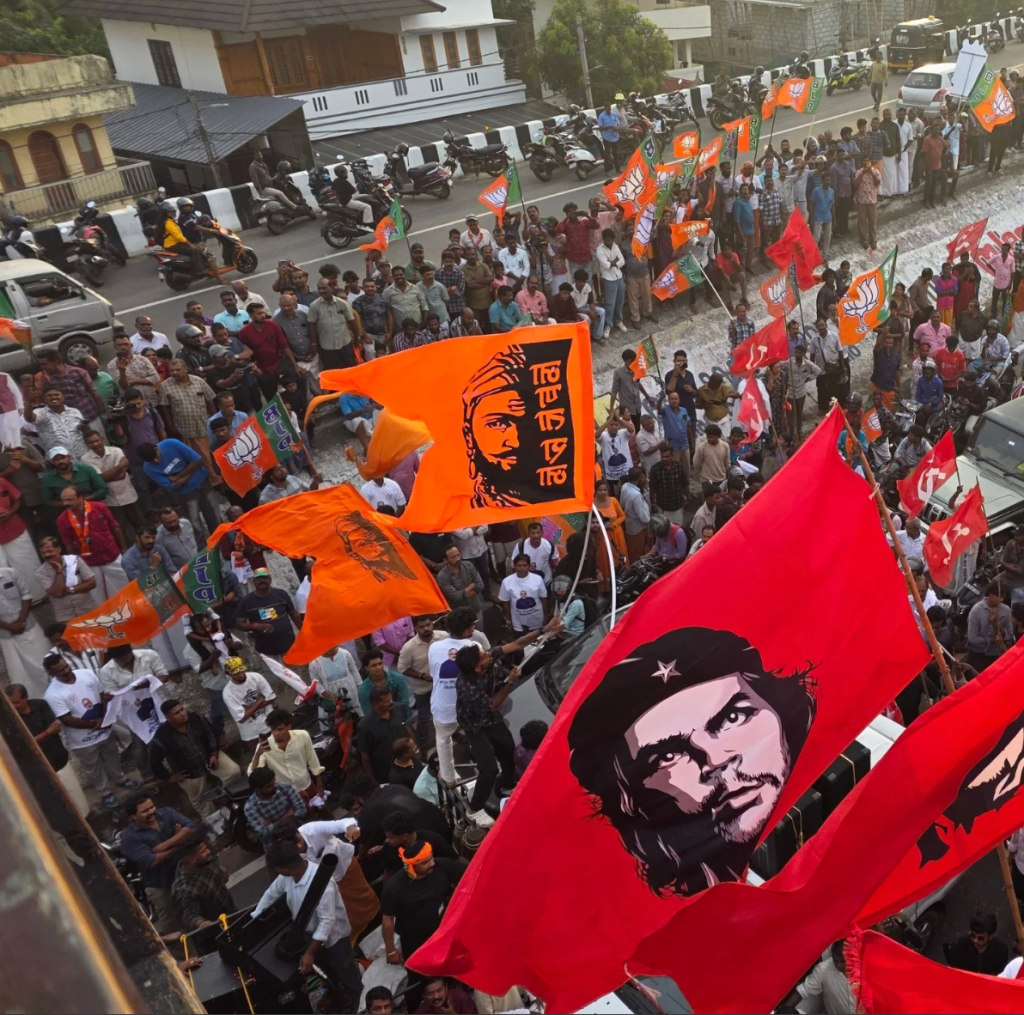
A glimpse of ‘Kottikalasham’, where cadres from all the major parties gather at a central location of the constituency to showcase their strength and momentum to the tune of popular songs and high-tempo music.
The most immediate difference lies in the nature of voter engagement. In many northern states, political communication is designed around persuasion at scale. Messages are simplified, repeated, and amplified until they cut through. In Kerala, that approach quickly runs into limits because the voter is already deeply engaged and often arrives at the conversation with prior information, formed opinions, and a willingness to question what is being said.
In much of northern India, parties often function as vehicles for leadership, identity blocs, or broad narratives that can override local dissatisfaction for the duration of an election. In Kerala, parties are seen less as vehicles and more as institutions with a track record that is continuously evaluated. Voters carry a memory of governance that is not easily displaced by short-term messaging. This is why sudden shifts driven by a single issue or personality are relatively rare.
The question of welfare illustrates this difference clearly. In many states, the announcement of new benefits can have a direct and immediate electoral impact, particularly when basic service delivery remains uneven. In recent elections across northern India, there has been a visible trend where incumbent governments attempt to lock in electoral advantage through direct benefit transfers in the final weeks before polling. Bihar in 2025 and Madhya Pradesh in 2023 saw variations of this approach, and similar strategies have been deployed in Assam in 2026. These interventions are designed to create an immediate, tangible connection between the voter and the state at the precise moment of decision-making.
Kerala does not respond to this in the same way. Welfare is already embedded in the political system and treated as an entitlement rather than a favour. When announcements are made, or when money is deposited close to elections, the first reaction is often not gratitude but scrutiny. Questions are raised about fiscal sustainability, about how the state intends to meet these commitments given the condition of its finances, and about whether such measures are politically timed rather than structurally sound. This does not mean welfare is irrelevant, but it does mean that it cannot substitute for broader assessments of governance. The space for purely transactional politics is far narrower.
Basic amenities such as roads, electricity, and water are not absent from political discussion, but they do not dominate it in the same way because they are largely seen as baseline responsibilities that any government must fulfil. The conversation moves quickly beyond access to questions of quality. Voters speak about the condition of infrastructure, the efficiency of public services, the functioning of schools and hospitals, and the opportunities available to younger generations. There is a clear sense that governance must keep pace with rising expectations, and when it does not, dissatisfaction accumulates even if the fundamentals remain intact.
It also influences how anti-incumbency operates in Kerala. In northern India, anti-incumbency is often visible and sometimes abrupt, triggered by identifiable failures or strong counter-narratives. In Kerala, it tends to build gradually. A government may continue to be seen as competent, yet still face erosion in support because expectations have outpaced delivery. The last decade reflects this pattern, in which no single failure defines the political mood, but a series of smaller concerns together creates pressure on the incumbent LDF.
Another important distinction lies in how voters assess individual candidates. In many states, the party symbol or top leadership can outweigh the local candidate’s profile. In Kerala, the MLA is subject to close and continuous scrutiny. Accessibility, responsiveness, and visible engagement within the constituency matter significantly. Voters often separate their evaluation of the state government from their assessment of the local representative, and this can produce outcomes in which a strong candidate withstands an unfavourable broader trend, or, conversely, a weak candidate underperforms despite a favourable environment for the party.
Social identities continue to play a role, but their influence is mediated by other considerations. Communities retain historical alignments, yet these are not absolute. Voters are willing to deviate when local factors or governance performance provide sufficient reason. This creates a level of fluidity that is different from the more rigid bloc voting seen in several northern states. Political appeals that rely exclusively on identity without addressing performance tend to have limited traction.
The media and information ecosystem further sharpens this behaviour. Kerala has among the highest newspaper readership rates in the country, and this is complemented by near-universal mobile internet access. Political information flows constantly, not only through formal channels but through an active and highly creative digital culture. Instagram reels, Facebook posts, and WhatsApp forwards are not peripheral to the campaign but central to it. Political memes, often layered with references to Malayalam cinema and popular culture, travel quickly and widely. Parodies and voice-overs of well-known film scenes are routinely repurposed to comment on political events, and these formats often reach audiences that traditional messaging cannot.
In this environment, parties are not only judged on their official communication but also on how they are represented, adapted, and sometimes mocked in the wider digital conversation. Voters pay close attention to a party’s online presence, its advertisements, and even its surrogate content. A campaign that fails to engage meaningfully in this space risks losing narrative ground even if its formal messaging remains strong.
The popularity of “Pottiye Kettiye”, a viral parody song taking a dig at ‘comrades’ for stealing gold from Lord Ayyappa, stands as a testament to this pattern of political information consumption. It did not emerge as a controlled campaign asset pushed through official channels, but rather as a piece of content that resonated organically with a section of the electorate. By the time it was widely recognised, it had already shaped perception, particularly in the run-up to local body contests where it contributed to a perceptible dent in the Left’s narrative dominance.
The presence of a third political force, the BJP, has added a new dimension to this structure, though its significance is best understood in terms of margins rather than outright victories. Even modest increases in vote share have begun to affect the outcome in closely contested constituencies, introducing an additional layer of complexity into what was once a more predictable bipolar contest. This has required both major alliances to adjust their strategies, particularly in seats where small shifts can alter the final result.
Campaigning itself reflects these structural differences. Large rallies and central messaging remain part of the electoral landscape, but they are supplemented by sustained, detailed engagement at the local level. House visits, small meetings, and repeated interactions form the backbone of the campaign. The objective is not to introduce new information but to reinforce credibility and maintain presence. By the time the campaign reaches its final stages, most voters have already formed their preferences, and the role of campaigning is largely to consolidate rather than persuade.
The closing phase, marked by public displays such as ‘Kottikalasham’, serves as a visual culmination of this process. It is less about changing minds and more about signalling momentum, offering both cadres and voters a sense of how the contest is unfolding.
What emerges from all of this is a political environment in which elections are driven not by a single factor but by the interplay of multiple considerations, carefully weighed by the voter. The absence of dramatic swings does not indicate a lack of change, but rather a more measured and deliberate form of political decision-making.
For a political consultant accustomed to the dynamics of northern India, the lesson is straightforward but not easy to implement. Kerala does not reward simplification. It requires a campaign to engage with voters who are attentive to detail, conscious of performance, and unwilling to separate political choice from lived experience.
Kerala is a reminder that electoral behaviour in India is not uniform, contrary to the popular judgment.


Leave a Reply